


How red or blue is your state?
In the last ten elections, 41 states voted for the same party eight times or more.
Updated May 7, 2026by the USAFacts team


In American political discourse, states are often labeled “red” for leaning towards Republican politics or “blue” for leaning Democratic. State political profiles are shaped by a host of factors — voting patterns in national elections, the party affiliations of governors and congresspeople, and state laws.
Most states vote and act consistently along party lines, but some have less predictable political leanings. These states, which can “swing” to either major party in a presidential election, are sometimes called “swing states” or “purple” states.
How have red and blue states voted in presidential elections?
Voters in most states stick with presidential candidates from one party: In the 10 presidential elections held since 1988, 41 states stuck with candidates from the same party eight times or more. Twenty of them, along with Washington, DC, voted for the same party’s candidates in all 10 elections.
Get weekly insights
Subscribe for data-driven insights. No spin, just the facts.
Nine states — Colorado, Florida, Iowa, Michigan, Nevada, Ohio, Pennsylvania, Virginia, and West Virginia — voted for each party at least three times in those nine elections, making them less consistent.
Six states — Arizona, Georgia, Michigan, Nevada, Pennsylvania, and Wisconsin — voted for different parties’ candidates in the last two elections.
How has your state voted?
Click to view the margins of victory for the last 10 presidential elections.
Source: Federal Election Commission
In the 2024 presidential election, the states with the widest margins of Republican victory were Wyoming (+46 percentage points), West Virginia (+42), Idaho (+37), North Dakota (+36), and Oklahoma (+34).
Across the aisle, 2024’s bluest states by presidential voting margin were Vermont (with a margin of victory of +32 percentage points), Maryland (+29), Massachusetts (+25), Hawaii (+23), and California (+20). Washington, DC, had a margin of +84 points in favor of Democratic candidate Kamala Harris.
Explore presidential election results by state since 1988.
Margin of victory in presidential elections, colored by margin size and party
Source: Federal Election Commission
How do red/blue state labels apply to Congress?
The politics of the representatives states send to Congress also affect the states’ political reputations.
Senate party affiliations
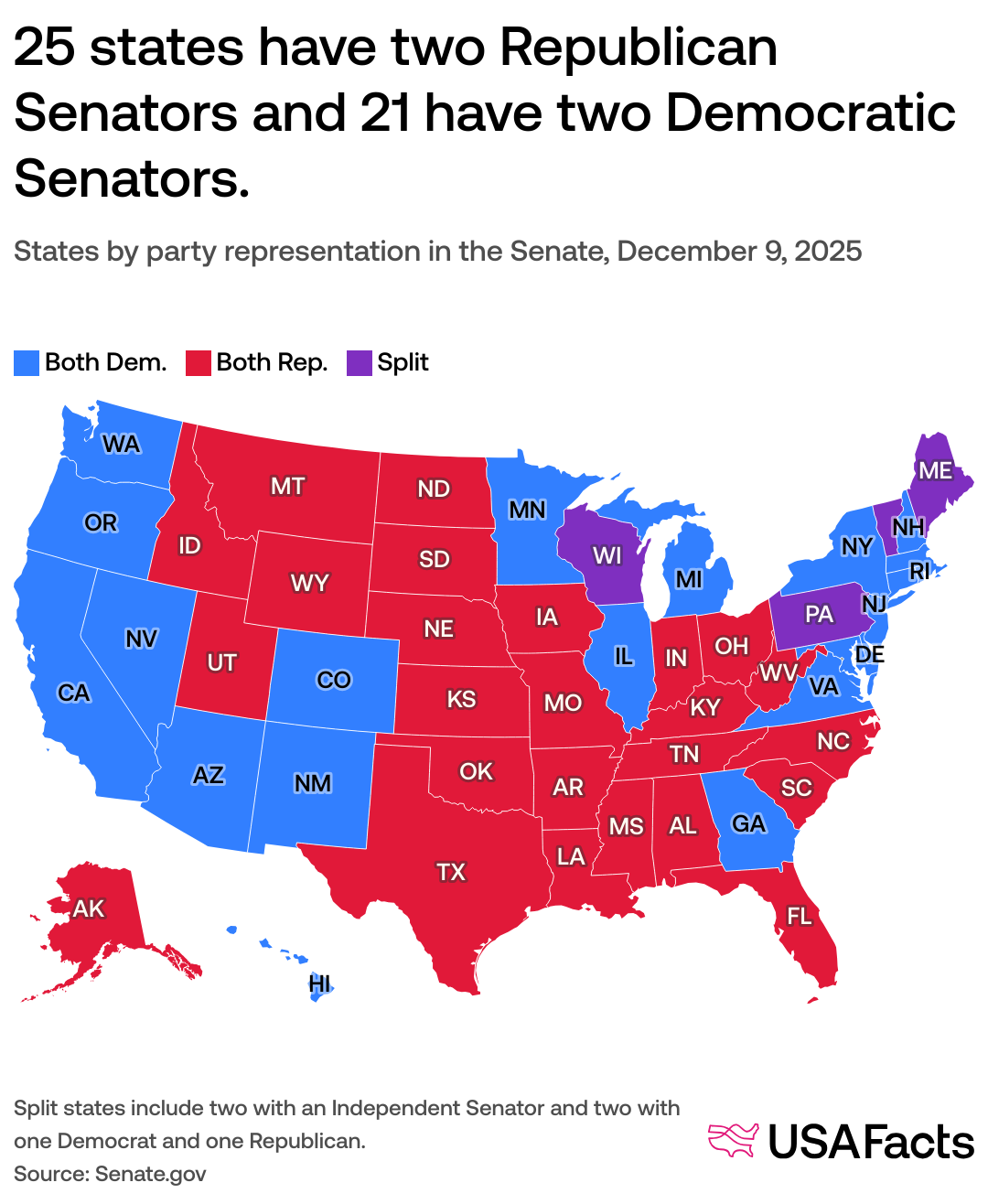
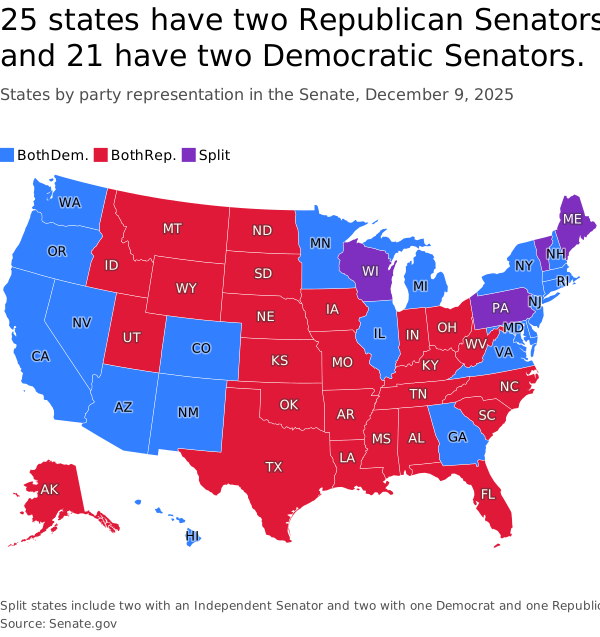
Each state elects two Senators. As of May 2026, 25 states have a pair of Republican Senators, 21 states have a pair of Democratic Senators, and four have some combination of Republican, Democrat, and independent Senators.
25 states have two Republican Senators and 21 have two Democratic Senators.
States by party representation in the Senate, May 7, 2026
A map showing states by party representation in the Senate in May 2026. 25 states have two Republican Senators and 21 have two Democratic Senators. Four are split.
Both
Dem.
Both
Rep.
Split
TXTXCACAMTMTNMNMAZAZNVNVCOCOWYWYORORUTUTMNMNIDIDKSKSNENESDSDAKAKNDNDOKOKMOMOWAWAGAGAFLFLMIMIILILIAIAWIWIARARALALNCNCNYNYLALAPAPATNTNOHOHVAVAININMEMENJNJRIRI
Split states include two with an Independent Senator and two with one Democrat and one Republican.
Source: Senate.govGet the dataEmbed Download imageDownload SVG
US Senate blue states (both Democratic Senators)
- Arizona
- California
- Colorado
- Connecticut
- Delaware
- Georgia
- Hawaii
- Illinois
- Maryland
- Massachusetts
- Michigan
- Minnesota
- Nevada
- New Hampshire
- New Jersey
- New Mexico
- New York
- Oregon
- Rhode Island
- Virginia
- Washington
US Senate red states (both Republican Senators)
- Alabama
- Alaska
- Arkansas
- Florida
- Idaho
- Indiana
- Iowa
- Kansas
- Kentucky
- Louisiana
- Mississippi
- Missouri
- Montana
- Nebraska
- North Carolina
- North Dakota
- Ohio
- Oklahoma
- South Carolina
- South Dakota
- Tennessee
- Texas
- Utah
- West Virginia
- Wyoming
US Senate split states
- Maine
- Pennsylvania
- Vermont
- Wisconsin
House of Representatives party affiliations
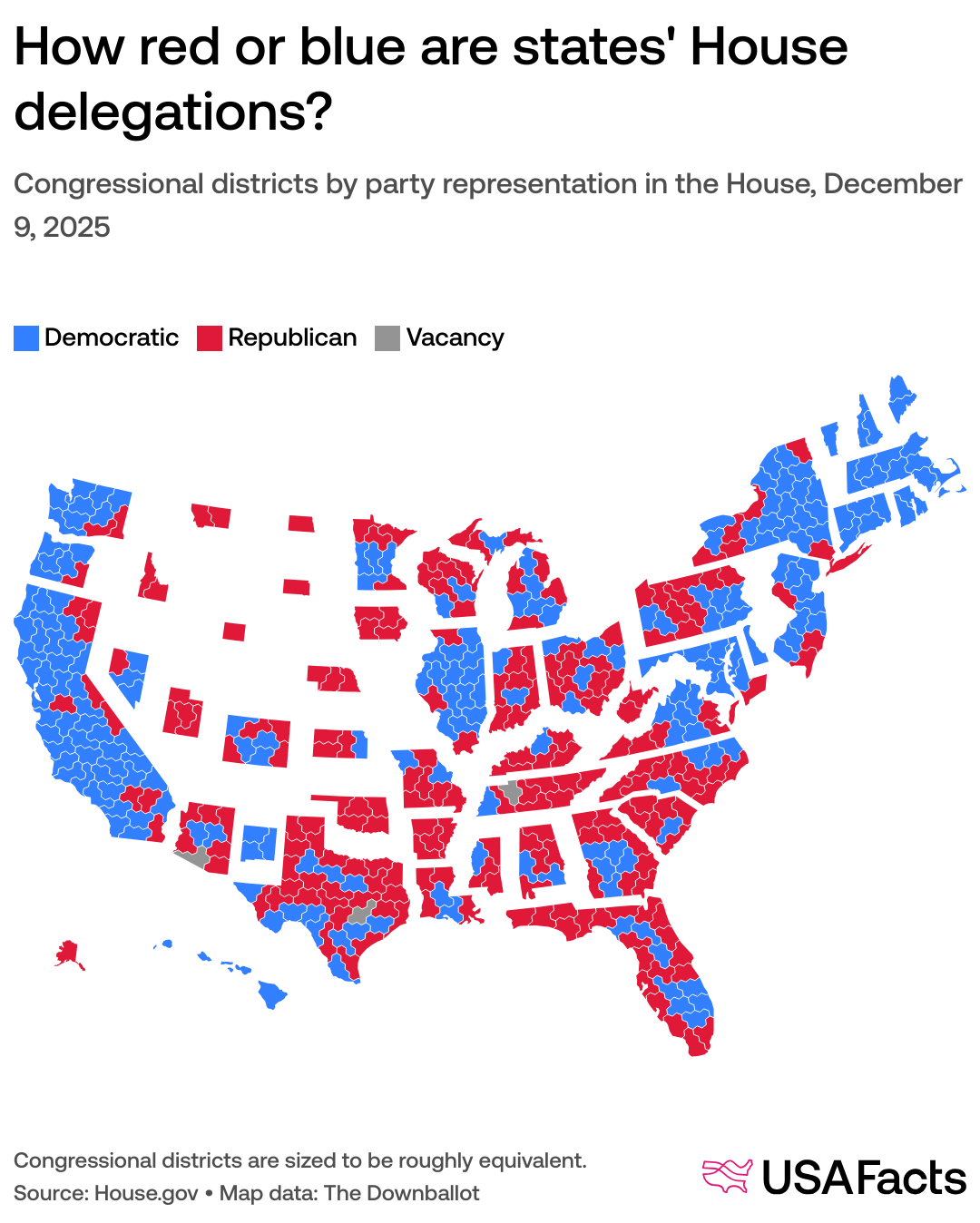
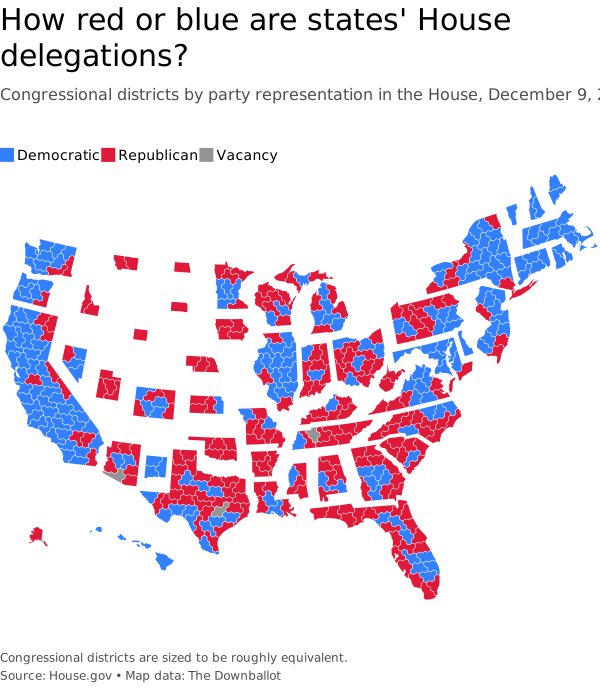
States have different numbers of Representatives, determined by population; six states have a single rep, and the remaining 44 have between two and 52. Most states with more than one representative have a combination of Republicans and Democrats in their delegations.
As of May 2026, the largest single-party delegation is from Massachusetts, where Democrats hold all nine seats. The largest all-Republican delegation is Oklahoma’s, with five.
How red or blue are states’ House delegations?
Congressional districts by party representation in the House, May 7, 2026
A hex map of congressional districts by party representation in the House in May 2026.
Democratic
Independent
Republican
Vacancy
Congressional districts are sized to be roughly equivalent.
Source: House.govMap data: The DownballotGet the dataEmbed Download imageDownload SVG
Which states have red or blue governors?
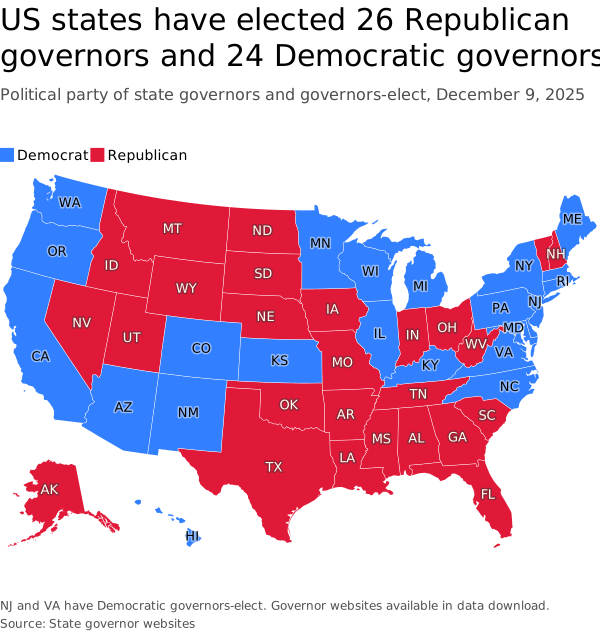
Another way to assess a state’s partisanship is by looking at its local leaders. Twenty-six states have Republican governors and 24 are led by Democrats, as of May 7, 2026.
US states have elected 26 Republican governors and 24 Democratic governors.
Political party of state governors, May 7, 2026
A choropleth map showing the political party of state governors. There are 26 Republican governors and 24 Democratic governors as of August 2024.
Democrat
Republican
TXTXCACAMTMTNMNMAZAZNVNVCOCOWYWYORORUTUTMNMNIDIDKSKSNENESDSDAKAKNDNDOKOKMOMOWAWAGAGAFLFLMIMIILILIAIAWIWIARARALALNCNCNYNYLALAPAPATNTNOHOHVAVAININMEMENJNJRIRI
Governor websites available in data download.
Source: State governor websitesGet the dataEmbed Download imageDownload SVG

States with Democratic governors:
- Arizona
- California
- Colorado
- Connecticut
- Delaware
- Hawaii
- Illinois
- Kansas
- Kentucky
- Maine
- Maryland
- Massachusetts
- Michigan
- Minnesota
- New Jersey
- New Mexico
- New York
- North Carolina
- Oregon
- Pennsylvania
- Rhode Island
- Virginia
- Washington
- Wisconsin
States with Republican governors:
- Alabama
- Alaska
- Arkansas
- Florida
- Georgia
- Idaho
- Indiana
- Iowa
- Louisiana
- Mississippi
- Missouri
- Montana
- Nebraska
- Nevada
- New Hampshire
- North Dakota
- Ohio
- Oklahoma
- South Carolina
- South Dakota
- Tennessee
- Texas
- Utah
- Vermont
- West Virginia
- Wyoming
Which states are reddest and bluest?
Partisan characteristics of each state and Washington, DC
Source: State websites and Congress
For more on how states vote, check out this article on swing states and sign up for our weekly newsletter.
Keep exploring
- What are the current swing states, and how have they changed over time?May 14, 2025
- How many Americans voted in 2020?Oct 3, 2024
- Reapportionment and redistricting after the 2020 census: ExplainedOct 21, 2022
- More voters are registering outside the two party system
Page sources
- Federal Election CommissionElection results and voting information
- SenateSenate.gov
See all