


It’s Up to Europe Now
Can Europe rise to the occasion?
MAR 3READ IN APP
Like many other Americans at the time, I spent the afternoon of the bicentennial — July 4, 1976 — at a cookout. In my case the cookout was in a park in Lisbon, Portugal, hosted by the American ambassador, who read to us a special message from Gerald Ford. I’ve always wondered how the embassy managed to find hot dogs — not exactly a Portuguese staple — for the occasion.
There were few Americans in Portugal at the time. Lisbon in 1976 was a sleepy backwater — not the tourist and mobile worker hotspot that it is today. And the U.S. deliberately kept a low profile. Portugal had overthrown its fascist dictator only two years earlier, and many people there were obsessed with the idea that Henry Kissinger, who had warned that Portugal might go Communist, would try to engineer a coup like the one that overthrew Chile’s Salvador Allende in 1973. There were graffiti on the walls saying “Morte ao CIA” (death to the CIA) although some of them added, in fresher paint, “e o KGB.”
So America tried to stay out of the limelight. In fact, there were so few official representatives of the U.S. government around that the cookout had to be filled out with lots of staffers from other Western embassies.
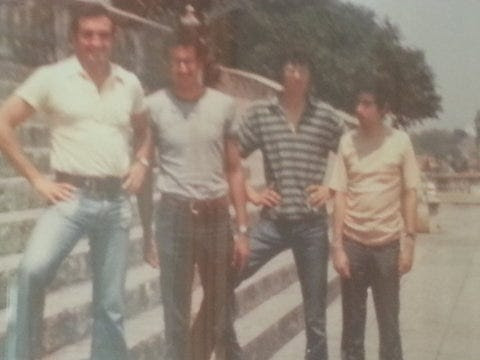
Oh, and what was I doing there? I was part of a small group of MIT graduate students who spent the summer working for Portugal’s central bank. That’s me below, on the far right:
Anyway, the point was that Portugal’s democratic forces needed all the help they could get. But America, which was persona non grata at the time, believed that it would be counterproductive to intervene in any visible way. So it was up to the Europeans to save a still-fragile democracy.
And they rose to the occasion. I don’t pretend to understand all the ins and outs, but by all accounts the Germans in particular provided crucial aid to pro-democracy parties, especially Portugal’s Socialists (who were really moderate social democrats.) The cause of democracy was also helped by the prospect that if Portugal remained democratic, it could expect not simply to join the European Union but to receive large-scale aid (“cohesion funds.”)
The reason I bring up this old history is that we have once again reached a moment when the future of democracy depends on Europe rising to the occasion.
Of course, the situation now is far more fraught than it was that long-ago summer. This time the democracy at risk is Ukraine, which is fighting for its life against Russian aggression. And the reason America won’t be there for a democracy in danger isn’t fear of political blowback: it’s the fact that the president of the United States has made it clear that he’s anti-democracy, admires Vladimir Putin and wants Russian aggression to succeed.
So it’s now up to European nations to rescue Ukraine.
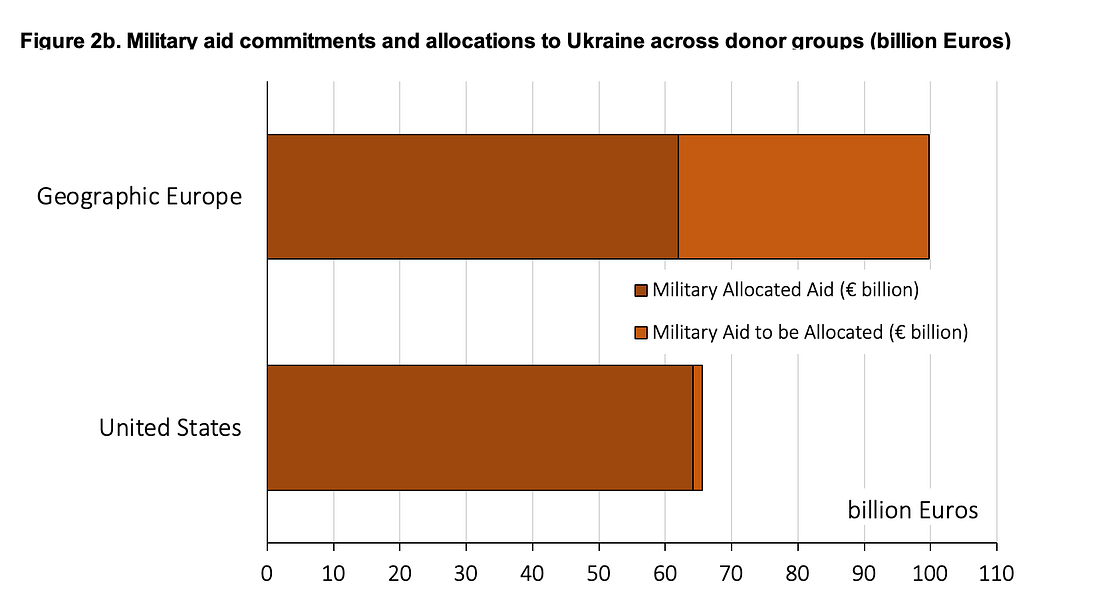
Does Europe have the resources to save Ukraine? Of course it does. The European Union and the UK combined have ten times Russia’s GDP. European aid to Ukraine has long exceeded US aid, and Europe could easily replace America’s share. In the early stages of the war, the US provided the bulk of the military aid, but even that gap has greatly narrowed:
Source: Kiel Institute